
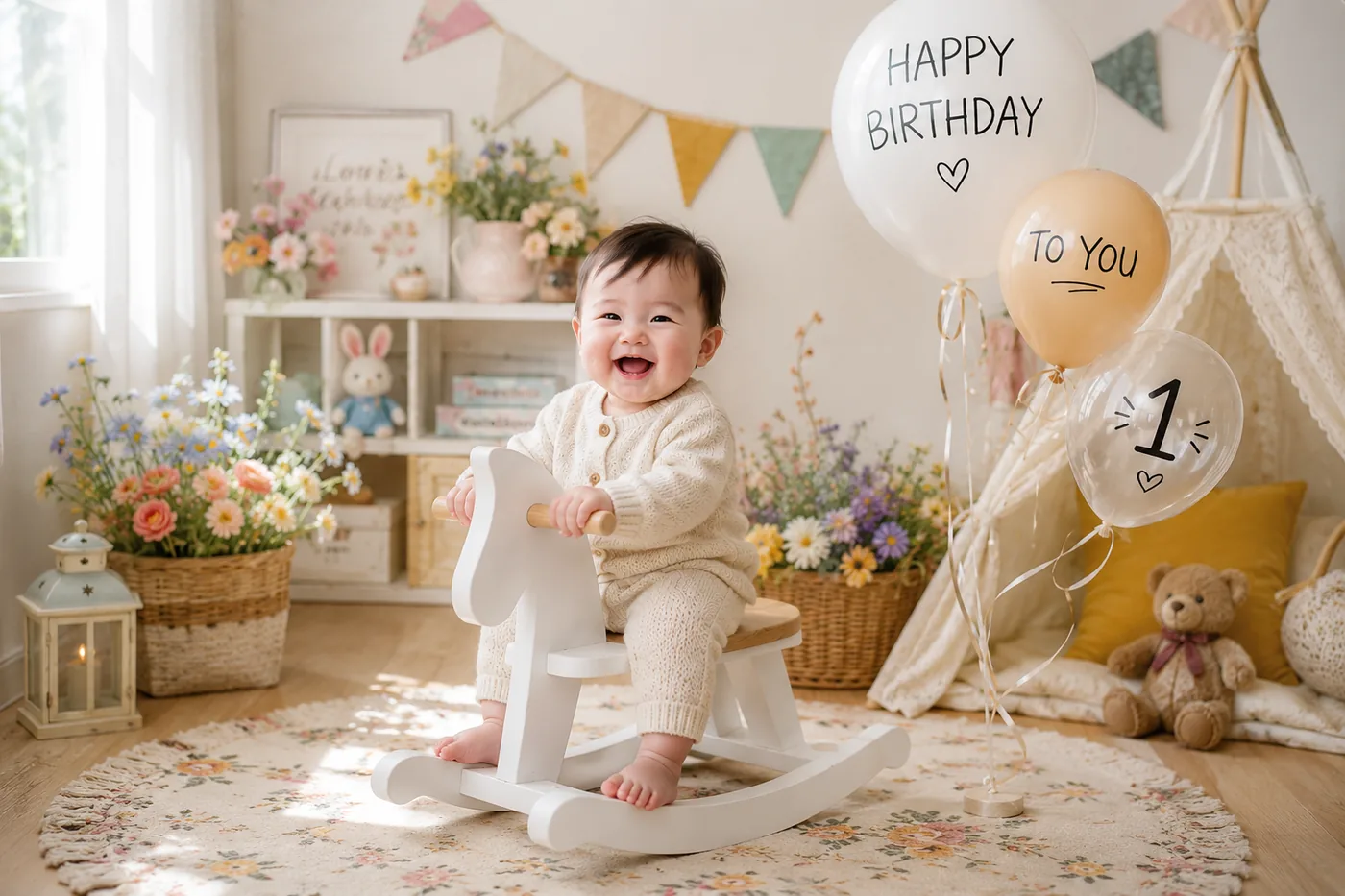
A first birthday photograph does not need a balloon wall, cake smash or a one-year-old willing to sit still. A strong collection shows what your child is like now, who helped them through the year and what the celebration felt like.
Plan a short photo story: start with a familiar activity, add a portrait and finish with family interaction. Continue later if your child needs a break.
Decide what you want to remember
Before choosing decorations, write down three details that feel specific to your child at twelve months. Perhaps they carry one book everywhere, clap when music starts, inspect every leaf, crawl at speed or hold a grandparent’s finger while walking.
Turn those details into photographs. They are more personal than a fashionable theme.
A useful first birthday shot list is:
- One clear portrait showing your child’s face.
- One wide photograph showing the home or celebration setting.
- One image with parents or carers.
- One with siblings or grandparents.
- One favourite activity or object.
- Hands, feet and another small detail.
- A candid photograph after everyone stops posing.
Eight first birthday photo ideas
1. The twelve-month “then and now” photograph
Echo one element from a newborn photograph: the same parent’s arms, window, colour or camera angle. Never force a one-year-old into a newborn position.
Hold the original print yourself rather than placing a glass frame or loose object beside the child. Another option is to create the side-by-side comparison later during editing.
2. A floor-level birthday portrait
Set up beside a window with a plain wall, clean rug or firm mat. Sit your child on the floor only if they already sit steadily; otherwise photograph them crawling, lying down or supported by a parent. Keep an adult within reach.
One sturdy board book can sit at the frame’s edge. Avoid small number blocks, loose faux flowers, beads and confetti.
3. The morning routine
Photograph the birthday before the party: pyjamas, breakfast, opening curtains or the usual book. Familiar morning routines are often calmer.
Use window light and take wide and close images. Keep some everyday details rather than clearing everything away.
4. A favourite-things portrait
Put two safe, age-appropriate favourites on a clear floor and let the child choose what to explore. Do not make them sit behind a display.
Check that toys are intact, age-appropriate and free of accessible batteries, magnets, cords or detachable small parts. See Product Safety Australia’s toy safety resources.
5. A family hand or footprint comparison
Photograph your child’s hand resting on a parent’s palm, fingers wrapped around a grandparent’s thumb or bare feet beside a sibling’s. Use natural interaction rather than paint if your child dislikes sensory materials.
If you use washable, non-toxic paint for a separate printmaking activity, follow the product instructions, supervise continuously and keep it away from the mouth and eyes. The photograph can be made after hands and feet are clean.
6. An Australian outdoor mini session
Choose open shade in your backyard or a quiet local park. Early morning or late afternoon usually gives softer light. Check the ground for ants, bindies, hot surfaces, broken glass and animal waste.
Keep the session to ten minutes. Bring water and sun protection, and follow current local UV advice. Avoid water edges, roads and play equipment when the photographer cannot also supervise.
7. One-year-old in motion
Photograph the movement your child already uses: crawling towards a parent, cruising along familiar furniture or walking while holding both of a parent’s hands. Use burst mode and frame wider than usual so sudden movement stays inside the photograph.
Do not place a child on a chair, crate or stool for visual height. Do not move furniture into an unstable arrangement. If standing requires support, keep the supporting adult and hands in the image.
8. The quiet end-of-day photograph
After guests leave, photograph a cuddle, a favourite book or the child sitting with a parent among a few remnants of the day. Remove broken balloons, food, candles, ribbons and small decorations first.
This frame often completes the story better than another staged smile. It shows the scale of the day from the child’s point of view.
A simpler approach to cake photos
Cake photographs can be enjoyable, but a dramatic “smash” is optional. A one-year-old may touch the icing once, refuse the cake, become overwhelmed or prefer a familiar food. None of these responses is a failed session.
Check the food before the camera
Use food your child already manages. Ask a health professional about allergies or feeding concerns rather than introducing an ingredient for a photograph. Remove candles, toppers, skewers, hard lollies, whole nuts and other choking hazards.
Pregnancy Birth and Baby advises supervising babies whenever they eat solid food and avoiding small, hard foods that can cause choking. Its introducing solid food guide provides current Australian guidance. If a child is choking or having trouble breathing, call Triple Zero (000); see choking and swallowed objects.
Seat the child safely
Use the child’s usual appropriate seating arrangement, follow its instructions and fasten the harness where provided. Never seat a child unsupported on a table, bench or decorative chair.
Keep one adult responsible for the child and another for the camera. The supervising adult should be close enough to remove food, steady the chair and respond immediately.
Use a small portion
A small portion or familiar soft food can give you curious hands and expressions with less waste. Photograph the first touch rather than waiting for a large mess.
Stop when the child is finished
Turning away, closing the mouth, throwing food or becoming upset are cues to end the activity. Do not smear icing on the child’s face to create a result. Clean hands and the seating area before the child touches decorations or crawls away.
Decorations that photograph well without creating clutter
Choose one strong visual element rather than many small ones.
- A coloured paper backdrop secured completely out of reach.
- A fabric colour already used in your child’s room, kept flat and away from the face.
- One large paper numeral mounted high and securely on the wall.
- A vase of native foliage placed well outside the child’s reach and removed immediately afterwards.
- The family’s dining table, verandah or backyard as it normally looks.
Avoid balloons around babies and young children. Broken or deflated balloon pieces can be choking hazards, and strings introduce entanglement risk. Product Safety Australia specifically advises not giving balloons to babies or attaching them to a cot, pram or stroller in its balloon safety guidance.
Also avoid confetti, water beads, button-cell lights, glass frames and lit candles near the child. Anything small enough to fit in the mouth stays out of reach.
A practical timeline for the day
Before the birthday
Charge the phone, clean the lens and clear storage. Write a short shot list, prepare a familiar outfit and test the location at the same time of day.
First five minutes
Begin with your child held by a parent or doing a familiar floor activity. Take the clear portrait early, before food, guests or outfit changes.
During the celebration
Assign one adult to take photographs for ten minutes, then put the phone away. Capture greetings, a present changing hands and the child watching people.
After the main activity
While another adult cares for the child, photograph a grandparent’s card, the cake, a favourite toy and the room from the child’s eye level.
At the end
Make one quiet family photograph. Back up the images that evening or the next morning, then select a concise set rather than keeping hundreds of near-duplicates in the main album.
Check before sharing party photographs
Birthday images often include other children, a home entrance, a venue sign or decorations showing a child’s full name. Obtain permission from the other children’s parents or guardians before posting, crop identifying details where practical and avoid captions that reveal a regular routine or precise location.
The Australian eSafety Commissioner recommends considering a child’s privacy and the possibility that an image may be copied beyond its intended audience. Its photo and video sharing guidance is a useful pre-post check.
Troubleshooting common first birthday problems
My child cries when we begin
Remove unfamiliar items and return to a parent’s arms. Check hunger, tiredness, temperature and noise. Try later rather than repeatedly presenting the setup.
The house is too dark
Move beside the largest window, turn the child towards the light and switch off mixed-colour ceiling lights. Increase exposure slightly on the phone. Avoid direct flash close to the child’s face.
Every photograph is blurred
Use burst mode, add more daylight and frame wider. Ask the child to move towards a parent rather than stay still. Select the sharpest moment later.
Guests keep stepping into the frame
Make the planned portrait before guests arrive. During the party, accept a documentary style. People crossing, reaching and laughing can provide useful context.
The cake photograph is not working
End it. Clean up and photograph a cuddle or favourite book instead. A cake reaction is only one possible detail in the birthday story.
First birthday photo checklist
- The shot list reflects the child, not just a theme.
- Floor setups are clear, stable and continuously supervised.
- Furniture, high chairs and toys are used only as intended.
- Decorations have no loose small parts, cords, glass or accessible batteries.
- Food is familiar, age-appropriate and served with close adult supervision.
- Candles, toppers and choking hazards are removed before eating.
- Outdoor ground, weather and UV conditions have been checked.
- The child can stop, eat, sleep or return to a parent at any time.
- At least one parent or carer appears in the final collection.
Frequently asked questions
What time of day is best for first birthday photos?
Use the time your child is usually most content, often after a sleep and meal. For outdoor photographs, combine that routine with open shade or softer early-morning or late-afternoon light.
Do we need a cake smash?
No. A portrait, family cuddle, favourite routine and “then and now” comparison can tell a fuller story. If you include cake, keep the portion and setup simple and supervise eating closely.
What should a one-year-old wear?
Choose familiar clothing that allows normal crawling, sitting and movement. Avoid scratchy outfits, tight headbands, long cords and accessories with detachable pieces. Bare feet are often easier and safer indoors than slippery new shoes.
Can my child sit in a decorative crate or basket?
Skip containers. They can tip, trap fingers or encourage an unstable position. Use a clear floor-level mat or a parent’s securely supported lap.
How do I include siblings safely?
Place everyone on the floor or have the baby held by an adult. Give the sibling a simple job such as reading a board book beside the child. Do not require a young sibling to lift, carry or restrain the one-year-old.
How many final photographs are enough?
Ten to twenty varied images can cover the day well: portraits, relationships, action, setting and details. A smaller deliberate collection is easier to print, share and revisit.