
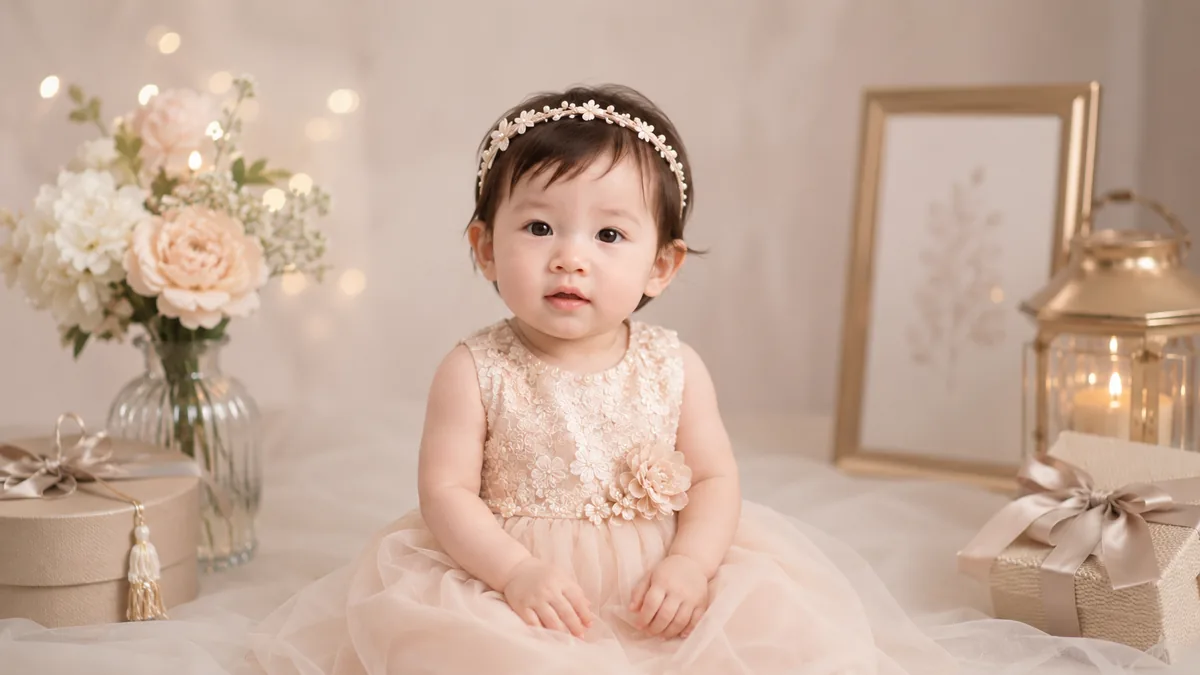
A monthly baby photo series works best when it records ordinary change: a newborn stretching, a hand finding a foot and expressions your family recognises immediately. It does not need twelve outfits or cooperation on the exact anniversary date.
Choose a format you can repeat in ten minutes. Keep the light, background and framing broadly consistent, then allow the activity to change with your baby’s development. If you miss a month, continue with the next one. The value is in the collection, not perfect compliance.
Choose a repeatable format
Before the first photograph, decide on four things:
- Location: a clear patch of floor beside a window is easier and safer than a bed or chair.
- Reference point: use the same plain mat, parent’s hands or familiar toy to show scale. Keep loose objects away from the face.
- Framing: take one overhead image and one close portrait each month.
- File label: save the best image as
baby-name-01-month-july-2026.jpg, changing the number and month as you go.
Photograph within a few days of the monthly date when your baby is usually fed and content.
Twelve monthly ideas
Development varies widely. These prompts are options, not a checklist of abilities your baby should demonstrate. Use only movements your baby already makes comfortably, and speak with your child and family health nurse or GP if you have concerns about development.
One month: the way they naturally rest
Photograph your baby on their back on a firm floor-level mat, with their head and face uncovered. Capture the full body first, then the curled fingers, milk-drunk expression and hairline. Include a parent’s hand resting gently beside the baby for scale.
Do not tuck the chin, arrange limbs tightly or use a pillow to hold the head.
Tiny detail to record: the way their hand wraps around one adult finger.
Two months: eyes finding faces
Lie beside your baby while another adult photographs from above, or hold the baby securely against your chest. Talk normally and wait for the moment their eyes settle towards a familiar face.
Photograph the connection rather than demanding eye contact. Side window light can brighten the eyes without flash.
Tiny detail to record: eyelashes, eyebrows or the expression just before a smile.
Three months: awake tummy-time moments
If your baby is comfortable with tummy time, photograph a short session on their usual firm, flat play surface. Stay at floor level and place the camera in front of them. A supervising adult must remain within reach throughout.
Do not lift the baby’s head or pull their elbows into a pose. If they rest their cheek down, photograph that. The Raising Children Network’s tummy-time guide recommends supervision and gradually building time according to the baby’s comfort.
Tiny detail to record: toes pressing into the mat.
Four months: hands at work
Photograph your baby discovering their hands, holding an age-appropriate toy or reaching towards a parent. Use a simple background so the gesture is easy to see.
Inspect the toy first. Avoid loose parts, long strings, accessible button batteries or detachable decorations. See Product Safety Australia’s toy safety guidance.
Tiny detail to record: the concentration in their face while grasping.
Five months: feet and movement
Photograph from the side as your baby kicks, rolls or reaches for their feet. Use burst mode for movement.
Do not hold the legs in position. Mobile babies can move off a surface quickly, which is why this setup belongs on the floor, not a bed or change table.
Tiny detail to record: wrinkled soles and curled toes.
Six months: half-year family portrait
Make this month’s image about relationships. Sit on the floor with your baby securely supported on your lap and include the people important to your family.
If your baby is not sitting independently, do not prop them with cushions for the photograph. A parent’s hands can remain visible around the torso. The support becomes part of the story.
Tiny detail to record: everyone looking at the baby instead of the camera.
Seven months: favourite everyday object
Choose one familiar, age-appropriate object, such as a board book or well-loved toy. Photograph your baby exploring it during normal floor play.
Keep the scene uncluttered and supervise closely. Remove the object when the photograph is finished, especially if it is not intended for unsupervised use.
Tiny detail to record: hands turning a thick book page.
Eight months: supported or independent sitting
If your baby already sits steadily, use a firm mat with clear space and an adult within reach. If they need support, sit behind them and keep your hands in frame.
Avoid chairs, boxes and cushions. The photograph should reflect the ability your baby has today, not a milestone manufactured for the picture.
Tiny detail to record: the serious expression that often comes with balancing.
Nine months: the view from their level
Photograph your baby crawling, pivoting, shuffling or reaching towards you. Let them enter and leave the frame.
Clear the floor of cords, small objects and unstable furniture first. Put the phone down if supervision requires both hands.
Tiny detail to record: knees, palms or the look back over a shoulder.
Ten months: a real routine
Photograph part of your ordinary day: choosing a book, sitting with a parent after breakfast or looking out a window while held safely.
Keep bath time off the photography list unless a second adult is wholly responsible for close supervision. Water safety requires undivided attention.
Tiny detail to record: a familiar object in the home that may change over time.
Eleven months: personality in motion
Use a game your baby already enjoys, such as peekaboo with a parent, clapping or dancing while securely held. Start recording a short Live Photo or burst before the expected expression, then choose the sharpest frame.
Avoid repeated loud noises, dangling treats or taking away an object to provoke a reaction. The aim is to notice personality, not manufacture it.
Tiny detail to record: their current favourite expression, including the grumpy one.
Twelve months: then and now
Recreate the basic framing from month one on the same floor-level background. Do not expect the baby to lie still. Let them sit, crawl or stand with support they already use. Place the first-month photograph nearby only if it is mounted securely and has no glass.
Then make a family portrait. The adults have changed during the year too, and their presence gives the series context.
Tiny detail to record: a hand comparison with the same parent from month one.
Three alternatives to number blocks
Monthly blocks and letterboards can become visual clutter and may contain small removable parts. These simpler methods keep attention on the baby.
Add the month later
Take a clean photograph and add a small date in your phone’s editing app. Use the same font and corner each month. Keep an untouched original as well.
Photograph the same wide scene
Use the same safe corner of the home and allow favourite toys, books and movement to change naturally. Consistent framing makes the progression clear.
Pair the photograph with one sentence
Keep props out of the frame and write one specific line in a private album instead: a new sound, a familiar expression or the routine that defined that month. The words make twelve visually simple photographs feel personal without asking the baby to perform for a sign.
A ten-minute monthly workflow
- Feed, change and settle your baby as usual.
- Clear the floor and open the curtain for soft daylight.
- Clean the phone lens and disable flash.
- Take one safe overhead or eye-level full-body frame.
- Take one interaction with a parent.
- Photograph hands, feet and one current habit.
- Stop when the baby has had enough.
- Favourite three images and back them up that day.
- Add one sentence about the month in the file notes or family album.
That final sentence can be as meaningful as the image: “You laughed whenever the dog sneezed” is more personal than a generic milestone sign.
Keep the series private enough for your family
If you share monthly photographs, avoid combining a full name, exact birth date and regular location in the image or caption. Check letter boards, hospital bands, calendars and the background for identifying details. Ask permission before including another child, and consider a private family album instead of posting every image publicly.
The Australian eSafety Commissioner explains that privacy settings reduce exposure but cannot prevent someone from copying or reposting an image. Decide what belongs in the family archive before choosing what belongs online. Read Privacy and your child for current guidance.
Troubleshooting the series
The light changes every month
Use the same window at a similar time. Turn off artificial lights and adjust brightness later. Seasonal light can remain part of the record.
My baby will not look at the camera
Photograph what they are looking at. A parent can sit beside the lens and talk softly. Looking away can still make a truthful monthly photograph.
We missed a month
Do not recreate it later or change the date. Continue with the baby’s current month. Label by date as well as age so the record stays honest.
The setup has become unsafe for a mobile baby
Retire it. A background that worked for a newborn may not work for a crawler. Move to an open floor area and use a wider frame. Safety matters more than visual consistency.
My child is not doing the suggested milestone
Choose a different prompt. Monthly photography should never become a developmental test. Record eye contact, sounds, favourite routines, hand movements or relationships instead.
Monthly photo checklist
- The setup is at floor level or the baby is securely parent-held.
- The activity matches abilities the baby already uses comfortably.
- An adult is within reach and focused on supervision.
- Loose fabric, cords, small parts and unstable props are removed.
- Tummy time is awake and continuously supervised.
- A tired or sleeping baby will go to their normal safe sleep space.
- The session can end as soon as the baby turns away or becomes unsettled.
- The selected images are backed up in at least two places.
Frequently asked questions
What day should I take each monthly photograph?
Use the anniversary date if it suits your family, but a nearby calm day is fine. Consistency matters less than photographing when your baby is comfortable and you are not rushed.
Should every month use the same outfit?
No. A similar plain bodysuit can show physical change, but seasonal clothing and favourite outfits also tell the story. In Queensland, prioritise a comfortable room temperature and avoid overdressing for the photograph.
Can I use balloons or confetti as monthly props?
Skip them around babies. Broken or deflated balloons and small decorations can become choking hazards. Product Safety Australia advises against giving balloons to babies or attaching them to a cot, pram or stroller.
How many photographs should I keep each month?
Keep a small edited set: one full view, one close portrait, one relationship and one detail. Keep the originals backed up, but use the shortlist for an album so the project remains manageable.
Is it safe to photograph a sleeping baby on a styled blanket?
Do not use a photography setup as a sleep space. Follow Red Nose safe sleeping guidance: place baby on their back in their own safe sleep space, on a firm, flat surface with their head and face uncovered.