
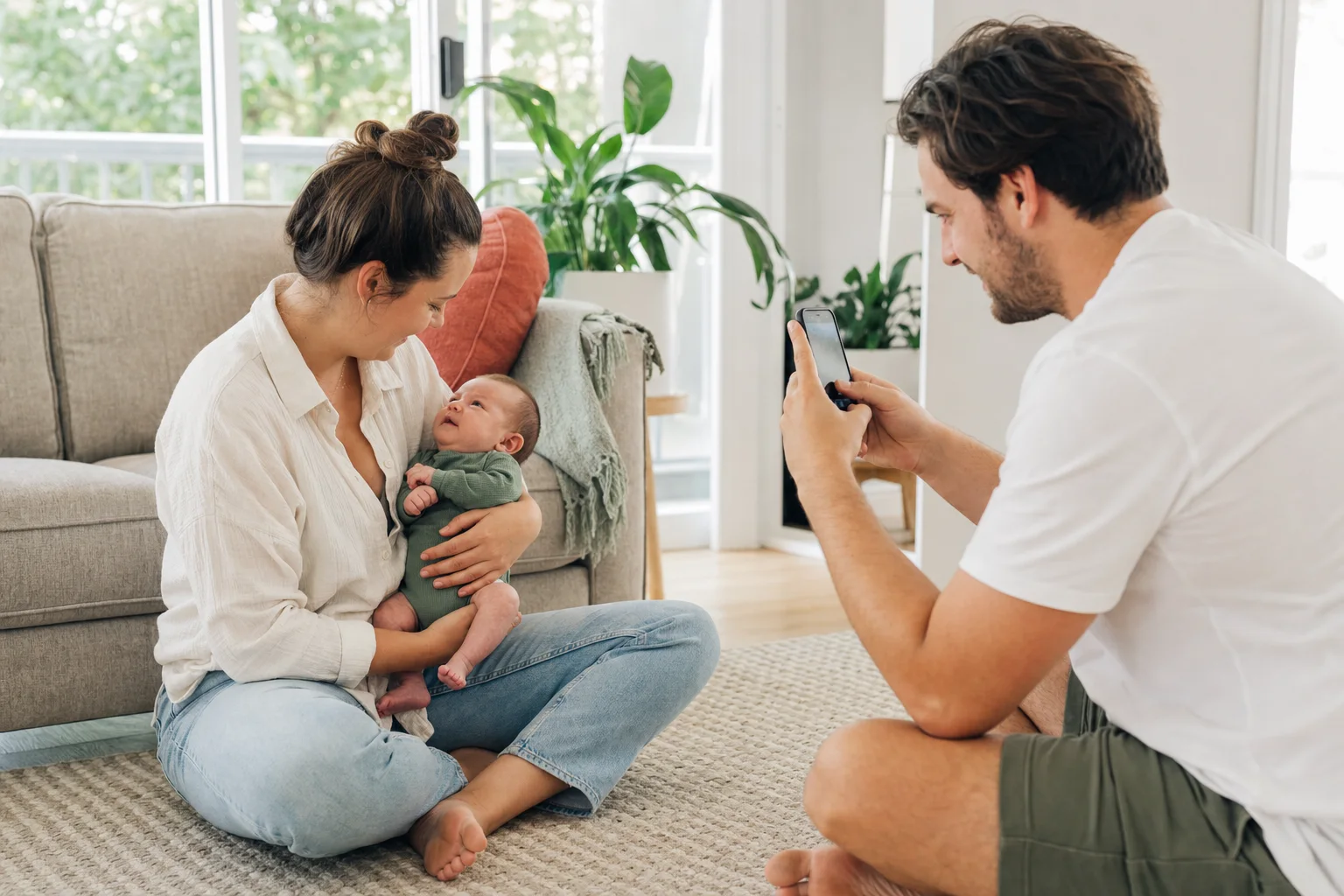
The safest baby photograph is usually the simplest one: your baby lying naturally on a clear surface at floor level, resting securely in a parent’s arms, or playing while an adult stays within reach. You do not need a basket, elaborate pose or sleeping baby to make a photograph worth keeping.
This guide is for casual photographs made by parents at home. It is not a posing manual for complex newborn portraits. A photograph is never important enough to test a baby’s balance, restrict their airway or turn an unsuitable object into a sleep surface.
The non-negotiable safety boundaries
Use these rules before choosing a backdrop, outfit or camera angle.
- Keep the setup on the floor whenever your baby is not being held.
- Keep one responsible adult beside the baby and focused on supervision, not photography.
- Support a newborn’s head and neck whenever they are being moved or held.
- Keep the baby’s nose and mouth visible and their chin away from their chest.
- Stop the photo session if your baby turns away repeatedly, stiffens, slumps or cries. Settle them and try another day.
- Remove cords, glass, hot lights, unstable stands, pets, loose decorations and choking-sized objects.
- Never leave a baby posed while you step away to adjust the camera.
Becoming unusually drowsy or difficult to wake, having trouble breathing, or developing pale, blue or blotchy skin can be signs of serious illness rather than ordinary photo-session fussiness. Call Triple Zero (000) for urgent medical help. Healthdirect explains these and other warning signs in Symptoms of serious illness in babies and children.
Red Nose Australia advises that babies sleep safest on their back in their own safe sleep space, on a firm, flat surface with their head and face uncovered. Read the current Red Nose safe sleeping guidance rather than treating a styled photograph as an example of safe sleep.
Setups to reject completely
Do not copy a photograph that requires any of the following:
- Elevated props: tables, benches, beds, stools, shelves or stacked cushions create a fall risk, even before a baby can deliberately roll.
- Unsupported composite poses: images of a newborn apparently holding up their own head, balancing on their hands or suspended in an object are often composites made from several photographs with hands supporting the baby. They are not DIY poses.
- Containers: buckets, crates, bowls, suitcases, drawers, toy boxes and baskets can tip, trap, scratch or restrict a baby. Padding does not make a container safe.
- Sleep-risk setups: adult beds, sofas, beanbags, feeding pillows, nests, inclined seats and piles of soft blankets are not safe infant sleep spaces. If your baby falls asleep, move them to their usual safe sleep space.
- Tight wrapping or restraint: do not improvise swaddling for a photograph or wrap over a baby’s face, neck or chest. Follow your health professional’s guidance and stop wrapping when development makes it unsuitable.
- Hanging fabric, cords or necklaces: these can obstruct breathing or create entanglement and strangulation hazards.
Product Safety Australia recommends using baby products only for their intended purpose and following the manufacturer’s instructions. Its Keep baby safe resources are useful when checking nursery products and toys.
Prepare the room before bringing in your baby
Do the fiddly work first. Choose a bright area near a window, out of direct midday sun. Place a clean play mat or firm blanket directly on the floor. A plain fitted sheet pulled smoothly over the mat can make a simple background.
Set your phone to photo mode, clean the lens and switch off the flash. Put it on silent if the shutter sound startles your baby. Test the framing with a rolled towel or soft toy, then remove the test object. Ask another adult to be the safety spotter. Their only job is to remain close enough to intervene immediately.
Keep the session short. Five calm minutes can produce more useful photographs than half an hour of repeated repositioning.
Seven genuinely safe pose ideas
1. On the back, photographed from directly above
Place an awake or settled baby on their back on the prepared floor-level surface. Keep the area clear and the face uncovered. Stand with both feet beside the mat and hold the phone over the baby’s chest, using the screen grid to keep the frame straight.
Do not stand on furniture or lean so far that the phone could fall. Use the 1x lens rather than holding the phone directly over the face. Include hands, feet and some empty background. A safety spotter should remain beside the baby.
2. Parent-held against the chest
Sit in a stable chair with both feet planted, or sit on the floor with your back supported. Hold your baby in the position you normally use, with their head and neck supported and airway clear. Ask another adult to photograph from slightly above your shoulder.
Photograph the whole embrace, then move closer for a hand on a tiny back or the baby’s fingers curled around clothing.
3. Over-the-shoulder cuddle
Use this only if it is already a comfortable, familiar hold for you and your baby. Support the baby’s body and head securely. The photographer can stand behind and to the side of the parent, focusing on the baby’s profile and the parent’s hand.
Check that fabric is not covering the baby’s nose or mouth. Never ask the parent to loosen their hold for a clearer view.
4. Side-by-side family photograph on the floor
Have the adults lie on a clean rug or mat, with the baby on their back between or beside them. Keep adult hair, loose clothing and bedding away from the baby’s face. Photograph from floor level for a line of profiles, or from above with the same no-climbing rule.
For siblings, position the baby beside the older child, not in their arms. Keep an adult ready to guide hands and sudden movement.
5. Supervised tummy-time portrait
Tummy time is for an awake, settled and continuously supervised baby. Use the firm, flat floor surface your baby already uses for play. Photograph at eye level while the supervising adult stays within reach. Never walk away to find a prop.
Photograph your baby’s natural position rather than arranging their arms or forcing a higher head lift. The Raising Children Network advises close supervision during tummy time; see its tummy-time guide.
6. Supported sitter with a parent in frame
Use this only when your baby is already practising sitting and can hold their head steadily. Sit on the floor behind or beside them and support their torso with your hands. Keep the support visible. It tells the story of this stage and is safer than trying to edit the adult out.
Do not surround the baby with cushions or place them on a chair. A wobbling sitter can fall quickly. If they slump, tire or throw themselves backwards, return to a floor-lying or parent-held photograph.
7. Natural play at floor level
For an older baby, photograph a familiar activity: reaching for an age-appropriate toy, looking into a baby-safe mirror, turning board-book pages or crawling towards a parent. Remove small parts and check toys for damage first.
Sit on the floor and let the baby move through the frame. Avoid placing a treat or phone just out of reach to provoke an expression. Photograph concentration, curiosity and movement instead.
Make a simple setup look polished
Good light and composition do more than props.
- Face the baby’s body towards the window so light crosses the face softly.
- Move clutter out of the frame, not under or around the baby.
- Get close enough that the phone does not need digital zoom.
- Take one wide photograph, one closer view and three details.
- Finish with a few honest frames rather than chasing a perfect smile.
Troubleshooting common problems
My baby keeps turning away
Move the photographer towards the direction your baby naturally looks. A parent can speak softly from beside the lens, but avoid rattling, clapping or repeated loud noises close to the baby’s ears.
The photograph is blurry
Open the curtains, move closer to the window and brace your elbows. Use burst mode for kicking, waving or crawling.
My baby will not stay in position
That is useful information, not a problem to overcome. Switch to parent-held photographs or natural play. Never pin arms, wedge the body or keep returning a baby to a pose they resist.
My baby fell asleep during the setup
End the photograph and transfer your baby to their normal safe sleep space. Do not leave them sleeping in a styled setup, on an adult bed or among soft items. Red Nose’s guidance applies day and night, even when an adult is nearby.
An older sibling is too excited
Photograph the children separately, then ask the older child to sit beside a parent who is holding the baby. Avoid asking a young child to carry or restrain the baby for the camera.
Five-minute safety checklist
- The baby is on the floor or securely held by an adult.
- A separate adult is within reach and supervising.
- The head, neck and airway are supported and clearly visible.
- There are no containers, elevated props, cords, glass or small loose objects.
- The surface is firm and the baby’s face is clear of loose fabric.
- The phone and camera strap cannot fall onto the baby.
- The room is comfortable and the session can stop immediately.
- A sleeping baby will be moved to their usual safe sleep space.
Frequently asked questions
Can I pose my newborn on an adult bed if I stay beside them?
Use a prepared floor-level surface instead. An adult bed introduces soft bedding, gaps and a fall edge. It can also blur the distinction between a temporary photograph and a safe place to sleep.
Is a basket safe if it is weighted and padded?
No basket is necessary for a home photograph, and weighting or padding does not remove tipping, trapping, airway or surface risks. Choose a floor-level photograph with the baby on their back or in a parent’s arms.
Can I photograph a baby asleep on their tummy?
Do not place a baby on their tummy for sleep. For home photographs, tummy time should be awake, settled and continuously supervised. Follow Red Nose advice to place babies on their back for sleep.
Are pillows safe for helping a baby sit?
Do not use pillows to manufacture a sitting milestone. Photograph your baby lying down, playing naturally or sitting with a parent’s hands visibly supporting them.
When should I stop the session?
Stop at the first sign that your baby is uncomfortable, tired, hungry, cold, hot or repeatedly resisting. Feeding, settling and sleep take priority. A calm photograph on another day is always the better result.